So a while back I was guility of SWI (surfing while intoxicated) and I rounded out my collection of Micronauts comic books. For me this was THE comic of my childhood. Micronauts were my favorite toys, at that age when a little boy carries a pocket sized plastic hero-fetish with him everywhere. And upon discovering Marvel's comic series, which was loosely based on the toyline, I was hooked. This was one of the first comic-toy tie-in series, and to my knowledge the best to date. It wasn't started as an advertising gimmick, but because the original writer of the series, Bill Mantlo, thought the toys looked cool, and was inspired to do a space opera comic based on them.
And these stories really hold up. The series changed artists several times, so the art stumbles at points, but when it shines it SHINES! Michael Golden, Pat Broderick, and Butch Guice all did some amazing stuff here, with Danny Bulanadi inking. Bulanadi seems to really jam on Broderick's pencils, but when working with Steve Ditko, Howard Chaykin, and Gil Kane the collaborations seem forced and pedestrian. And the Golden and Broderick eras, man oh man, just great use of color, layout and Zip-a-Tone! The Zip-a-Tone sings in a way I've never seen since. The tone crazy Manga wannabes out there could really learn some lessons from the first two years of the Micros. It never overpowers, it only helps to give depth and reality to gorgeous pen and brush, and painterly coloring. These days when I see tone used it is like a crutch for some one who is too lazy to do hatching shades, or learn how to get calligraphic thicks and thins out of one stroke of a sable brush or crow quill. These issues really do stand out as iconic examples of the height of the bullpen system of analog comic production.
The comic was such a fan favorite, that despite having the broad readership of say Spider-Man, Marvel moved it to direct sales only in the early 80's. Even though I was one of those die-hard fans, for most of this time I didn't have a comic-book store in my area, so I missed most of these issues. I am reading them right now, and in a way it is like finding a lost unwritten chapter of my childhood. Perhaps that explains why I'm gushing, so.
There was a revival of the toy line in 2002, and a new comic series that gives some nods to the original, but due to copyright wierdness, is basically a different concept. I've the first few issues but it didn't capture me, the way the original did. But I'm sure at some point, I'll have to collect them, as well.
The toys themselves have an interesting history,dying and reborn as much as Baron Karza and Biotron. While both the toys and comics have been viewed as being knock-offs of the Star Wars franchise, the toys actually pre-date those movies, and the comic was being concieved (though not published) before Episode IV was orginally released.
The comics were so good in fact that there are still some quite good fan sites devoted to them and the toys.
The fan community is weird for Micronauts. I'm willing to bet I'm a good representative of it, guys in their mid-thirties who grew-up with the toys/comics. The kinda guys, many of whom now control much of the computer infostructure of this country. I mean the toys were geekier than the Star Wars toys. Every boy of our generation had handfuls of Star Wars toys. But the Micronauts had this Legos thing and this early Japanese culture fetishism thing going for them too.
Heck, there are even guys (one of whom has an Acroyear tattoo!) working on a new line of the action figures. Man do these look sweet! The release date on these puppies keeps getting pushed back, and it looks like they are going to be going for $20 a pop. I've never been one for the immediate collectible toy market, but I gotta say these would look awesome on my desk. Hell, I bet I'd get $20 bucks worth play outta 'em.
Whish! Zoom! ZAP!
Anyway, that's enough of my "Toys-R-Us" lifestyle for now.
I'll leave you fellow Micro-Nuts with this.

Sunday, October 01, 2006


Controlling Air Compressor Noise
For me the real downside of airbrushing is all the racket the danged compressor makes. Since you really need a compressor with a tank to ensure even airflow (not air that flows in spurts, which will be just what your paint does-- flow in pulses), this is mitigated somewhat because the compressor will only kick on when the pressure in the tank goes below a certain level. The downside to THAT is, you'll be jamming along painting, rocking to the backround music of your preference, and when that thing kicks on again the mild coronary it gives you might just cause you to make an errant mark on your masterpiece.
Some artists solve this problem by using tanks of CO2, like those used in soda fountains, but the chore of lugging those back and forth to be refilled would really be a chore for me right now. In the future that might be a great solution, because all I'd hear would be the sibilant purr of paint and air dancing on my substrate. Or if I could find a service that I could rent the tanks from, that would also deliver a replacement while picking up the spent tank, but that sounds like it could get expensive after a while.
There are also so-called "silent air compressors" but they frequently cost 4 to 5 times as much as a regular compressor.
Here is one guys solution:
Well, the neighbor finally complained about the noise. Ironically, she wasn't whining about the incredibly loud riveting, the incessant whining of the air drill, or the pounding on the C-frame dimpler. It was the compressor. "It's such a big generator," she said, "and it keeps going on and off, on and off."
I respect the complaint, because my garage acts as a megaphone and projects the compressor running noise right at her open windows. That kind of sucks. So I finally got around to soundproofing the thing.
Here's the corner where it sits, originally open like this. The motor is kind of tucked up under the shelf, but let's not kid ourselves...that doesn't do squat for noise reduction.
Anybody else out there in blog-land ever dealt with this, or have any ideas for doing this with as little expense and labor-intensity as possible?
Some artists solve this problem by using tanks of CO2, like those used in soda fountains, but the chore of lugging those back and forth to be refilled would really be a chore for me right now. In the future that might be a great solution, because all I'd hear would be the sibilant purr of paint and air dancing on my substrate. Or if I could find a service that I could rent the tanks from, that would also deliver a replacement while picking up the spent tank, but that sounds like it could get expensive after a while.
There are also so-called "silent air compressors" but they frequently cost 4 to 5 times as much as a regular compressor.
Here is one guys solution:
Well, the neighbor finally complained about the noise. Ironically, she wasn't whining about the incredibly loud riveting, the incessant whining of the air drill, or the pounding on the C-frame dimpler. It was the compressor. "It's such a big generator," she said, "and it keeps going on and off, on and off."
I respect the complaint, because my garage acts as a megaphone and projects the compressor running noise right at her open windows. That kind of sucks. So I finally got around to soundproofing the thing.
Here's the corner where it sits, originally open like this. The motor is kind of tucked up under the shelf, but let's not kid ourselves...that doesn't do squat for noise reduction.
Anybody else out there in blog-land ever dealt with this, or have any ideas for doing this with as little expense and labor-intensity as possible?
Aritst's Air, studio air filtration system
Have you pieced together from my posts that I'm looking for a way to control overspray and fumes from airbrushing? In fact, this system is very close to what I was initially thinking, but now I'm just going to keep some of their design features in mind, and design my own. But I know this has to be perfect for many artists out there, so I'm posting it. It ain't cheap, around $11oo, but well you ever sneeze in technicolor? Or get a little dizzy from your paint thinner? How much you think that will cost you and loved ones down the road? I ain't trying to promote this out of fear. Some art materials are REALLY bad for you, if you don't use a little common sense.
The Oil Pastel Society
So, most of you who know the Dragon in human form, know that I sold art supplies for nigh on seven years. A common scenario at my favorite independently owned art supply store, would be the well-meaning parent/relative/family friend, who wanted to nuture some youngsters blossoming talents, but for obvious reasons couldn't set them up with a full painting studio. My usual recommedation would be oil pastels. Available in price ranges from a buck or two for a set of twenty, all the way to $4 or 5 a stick, Cray-pas a good all-purpose beginner's brand can be had for about $3 for a basic set. Add a couple of cheap brushes, and a basic oil painting medium (perferably something lacking really toxic solvents,) and you've got a great "gateway" oil painting set for about ten bucks.
"Gateway oil painting?" you ask.
Well sure! Harder oil pastels, like Cray-pas are more like crayons than traditional pastels in feel, function, and composition. Heck some of you probably remember using them elementary school. But the genius thing about them, and where they differ from crayons (which are just a colorant and wax) is that they are composed of artist's pigments, wax, and oil. Therefore they are greasier crayons, and with a little effort can be blended together for hands on learning of color-mixing. Best of all they can be manipulated with oil painting mediums and brushes, at which point they really do magically transform into paint, though still significantly less messy than tube paint. A talented youngster starts learning a lot of applied painting, things that can be intimidating even to talented adults, with something as familar to them as a crayon.
I could ( and probably will) rant about oil pastels at length. But for now, if I've piqued your couriousity about these magic little sticks of color, check the Oil Pastel Society. Especially check out their archive of instructional primers. There is plenty there to get you started.
"Gateway oil painting?" you ask.
Well sure! Harder oil pastels, like Cray-pas are more like crayons than traditional pastels in feel, function, and composition. Heck some of you probably remember using them elementary school. But the genius thing about them, and where they differ from crayons (which are just a colorant and wax) is that they are composed of artist's pigments, wax, and oil. Therefore they are greasier crayons, and with a little effort can be blended together for hands on learning of color-mixing. Best of all they can be manipulated with oil painting mediums and brushes, at which point they really do magically transform into paint, though still significantly less messy than tube paint. A talented youngster starts learning a lot of applied painting, things that can be intimidating even to talented adults, with something as familar to them as a crayon.
I could ( and probably will) rant about oil pastels at length. But for now, if I've piqued your couriousity about these magic little sticks of color, check the Oil Pastel Society. Especially check out their archive of instructional primers. There is plenty there to get you started.
Denis Peterson, painter
A quite nice blog post about New York airbrush artist Denis Peterson. Airbrushing has a sort of unsavory aura about it in our culture. Most Americans, particularly those who are interested in the arts, view it as a bastardized medium, a commercial medium, a tool for deception and propaganda. Indeed the phrase "airbrushing" has a secondary meaning of glossing over, providing a spin-doctored interpretation. Few people understand why someone might persue airbrushing as a "fine-art" medium.
Well, I 'll save the rant about the artificial divisions of commercial art, crafts, and fine arts for another day. I do have some thoughts on the matter, but I'll save them for another post, and let Chris Rywalt ruminate on the issue for now:
At first glance his paintings seem marvels of precision and in many ways they are. But some of his effects are developed through surprisingly messy work: In one painting there's an almost perfect looking smashed plastic bucket, but if you look very closely you can see a big spray of paint right in the middle of it. You wouldn't think this would work but it does.
Denis told me about a curious technique he learned from his grandfather. Each line you see, he said, is actually three lines. He had some trouble explaining exactly how that worked, but the gist of it is where you think there's only one line, there's actually the end of one material, the beginning of the next, and the edge between them. He applies this to his paintings and it gives his work an interesting shimmer: The lines don't always match up flawlessly and that accounts for the off-register digital video coloration. Of course it may also be fidelity to his source materials. The photos Denis works from are sometimes heavily compressed and full of digital artifacts, and Denis, when he likes the effect, faithfully reproduces them. It's actually quite amazing. I've worked with digital image formats for years and have a very good eye for picking up certain features, so when I looked at Denis' Journey of a Thousand Nights, I was astonished to see what was clearly JPEG compression artifacts in the background grass. I wouldn't have believed anyone could reproduce them by hand, but Denis has.
As I mentioned earlier, though, Denis doesn't just reproduce photos. In fact one of my biggest questions was, "Why paint a painting which could be a photo?" Denis' answer involved some handwaving, but in the end it all comes down to the basic premise of art: That an image filtered through the mind of an artist has a value over a mechanical reproduction. The photos from which he works, Denis says, are just part of what he uses to create his paintings. Many details are added by his imagination; elements are emphasized, some are removed entirely. In Waterfront, the original photo had families posing in the foreground; Denis didn't put them in his painting. He's very conscious of the art involved in composing his images. He's very thoughtful regarding things like facial detail -- "I left these undefined because I wanted them to be timeless, like this scene is endless, just an endless line of women bringing firewood" -- and balance -- "I added this necklace because I wanted something detailed over on this side of the painting".
Well, I 'll save the rant about the artificial divisions of commercial art, crafts, and fine arts for another day. I do have some thoughts on the matter, but I'll save them for another post, and let Chris Rywalt ruminate on the issue for now:
At first glance his paintings seem marvels of precision and in many ways they are. But some of his effects are developed through surprisingly messy work: In one painting there's an almost perfect looking smashed plastic bucket, but if you look very closely you can see a big spray of paint right in the middle of it. You wouldn't think this would work but it does.
Denis told me about a curious technique he learned from his grandfather. Each line you see, he said, is actually three lines. He had some trouble explaining exactly how that worked, but the gist of it is where you think there's only one line, there's actually the end of one material, the beginning of the next, and the edge between them. He applies this to his paintings and it gives his work an interesting shimmer: The lines don't always match up flawlessly and that accounts for the off-register digital video coloration. Of course it may also be fidelity to his source materials. The photos Denis works from are sometimes heavily compressed and full of digital artifacts, and Denis, when he likes the effect, faithfully reproduces them. It's actually quite amazing. I've worked with digital image formats for years and have a very good eye for picking up certain features, so when I looked at Denis' Journey of a Thousand Nights, I was astonished to see what was clearly JPEG compression artifacts in the background grass. I wouldn't have believed anyone could reproduce them by hand, but Denis has.
As I mentioned earlier, though, Denis doesn't just reproduce photos. In fact one of my biggest questions was, "Why paint a painting which could be a photo?" Denis' answer involved some handwaving, but in the end it all comes down to the basic premise of art: That an image filtered through the mind of an artist has a value over a mechanical reproduction. The photos from which he works, Denis says, are just part of what he uses to create his paintings. Many details are added by his imagination; elements are emphasized, some are removed entirely. In Waterfront, the original photo had families posing in the foreground; Denis didn't put them in his painting. He's very conscious of the art involved in composing his images. He's very thoughtful regarding things like facial detail -- "I left these undefined because I wanted them to be timeless, like this scene is endless, just an endless line of women bringing firewood" -- and balance -- "I added this necklace because I wanted something detailed over on this side of the painting".
2007 Suzuki Burgman 400 Review
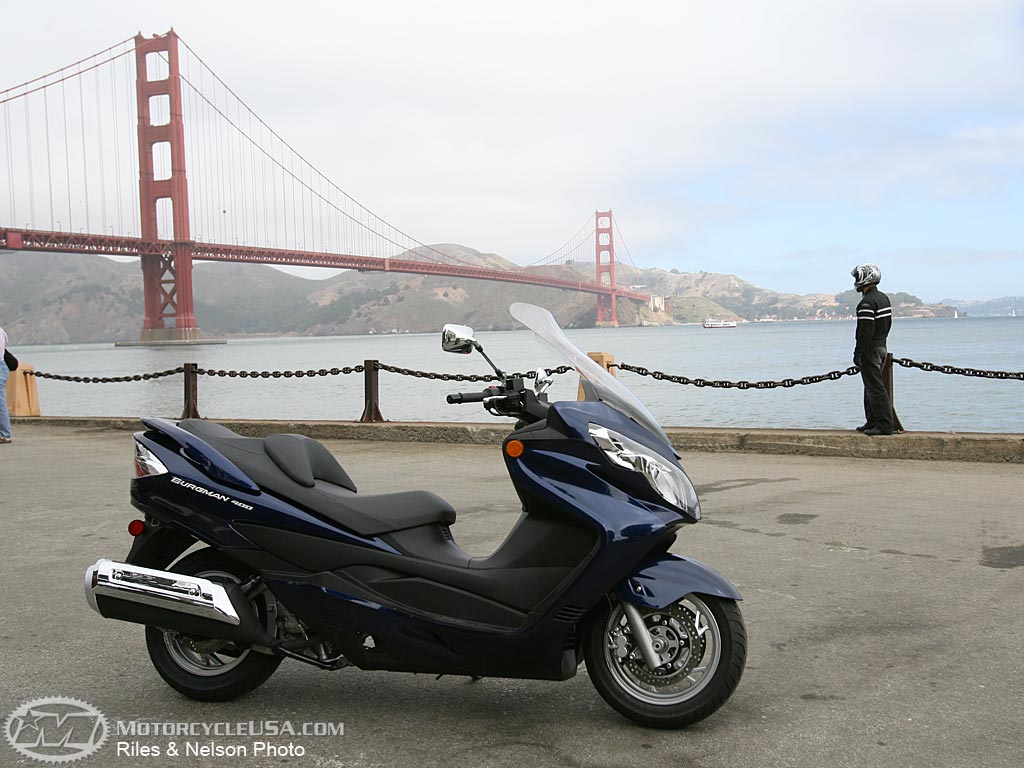
A very thorough review of the comfy Burgman 400. As I was saying in the previous post, it is a very comfortable scoot, even for the more long-legged scooterist. But not too comfortable, yes, it looks like a lazee-boy on wheels, but I really doubt you'll fall asleep in this thing, you'd be having too much fun. While it certainly is big, it's easier to handle and move around at low speeds than you would imagine, which is important to me. I like smaller, nimble bikes, not huge half-ton monsters. I'm not fond of the hump that is showing up in the middle of the floor boards of more and more modern scoots, and the Burg 400's hump is about as big as I can tolerate. Humps taller than that, and I wonder why they didn't just make it a motorcycle.
It turns out the average Burgman 400 rider has 12.4 years of riding experience under his or her belt, is 52.1 years of age, and has a household income of $71,884. Compare those figures to the rates of Suzuki's typical motorcycle owner: 12.1 years of riding experience, 38 years old, and $60,750 household income; and you don't have to be a statistics professor to draw some pretty general conclusions. For one, the Burgman ranks are made up of an older crowd. Another number that jumped out during Suzuki's presentation was the number of women riders making up the Burgman demographic, with 24% of the Burgman 400 customers hailing from the fairer sex compared to 12% of Suzuki's overall motorcycle owners. Another significant number is that extra $11,134 in income which, when combined with a more tempered outlook on street riding, makes the $5,899 MSRP an attractive one for those seeking a sensible form of two-wheeled transport.
Suzuki Burgman 650 Review
Recently Jes and I did some test-straddling at a local Suzuki dealership, whilst getting some safety gear. This dealer had the full range of Burgmans, the full Kymco range, and a used Helix. I found all but the largest Kymcos too confining, too much like that feet flat on the floor back straight posture your parents would make you imitate when eating at the dining room table (bet I'm dating myself with that one) or at a fancy dress-up restraunt. The Dragon has some long spindly legs, that cramp up if they aren't allowed to stretch and move around every five minutes or so. I've never been a fan of the looks of maxi-scoots, so I was quite surprised at just how much I liked the feel of the Burgmans. Actually the one that was most comfortable, for me, and for us (we tried most of the scooters to see how they would feel as driver and as passenger) was the Burgman 400.
But this article on the Burgman 650 is pretty interesting, it's definitely a highend machine (over $12k), but you definitely get some advanced technology for that price, as well as many luxury touches.
For starters, with a high-tech 638cc motor, it is powerful and comfortable enough for touring on the open road, which separates it from traditional scooters by a few light years. But it's not so much the machine but the SECVT which really impressed us the electronic gearbox is a foretaste of the future of commuting machinery and quite possibly of motorcycling in general. Manual Mode offers the ability of shifting up and down as on a motorcycle with a traditional gearbox and there are five pre-determined CVT ratios to shift through... There are two automatic modes: Normal and Power. In Normal Mode, the Burgman runs lower revs at any given road speed, conserving fuel and loping along in the traffic. Most scooters "buzz" or "scream" along the Burgman "lopes". Switch to Power Mode and engine rpm picks up, delivering more ponies per degree of throttle opening. A button on the handlebar toggles between the two modes... Now there's a point where being on a scooter is great, such as when it rains or when you need to store something. But there are other times when being on a scooter is not so great. It is clear after riding the bike for a couple of weeks, that many of motorcycling's brethren do not accept scooter riders as legitimate members of the two-wheeled fraternity.Pull up at the lights and nod to another two-wheeled commuter and the chances of getting a warm reply are greatly diminished if you are on a scooter. Quite strange really, and something we all noticed when riding either the Burgman or the Benelli Adiva.In motorcycling's pecking order, scooters are seemingly on the bottom rung!This rampant "scooterism" has a sure-fire cure when riding the 650 Burgman hit the power button and nail it the millisecond the lights go green.The get-up-and-go of the Burgman over the first 50 metres embarrassed a couple of litre-plus bike riders and positively humiliated a Harley Sportster rider who rode through a red light rather than face the Burgman a second time.The "magic button" is conveniently located on the handlebar panel and it aids the Burgman in producing very spirited performance indeed
But this article on the Burgman 650 is pretty interesting, it's definitely a highend machine (over $12k), but you definitely get some advanced technology for that price, as well as many luxury touches.
For starters, with a high-tech 638cc motor, it is powerful and comfortable enough for touring on the open road, which separates it from traditional scooters by a few light years. But it's not so much the machine but the SECVT which really impressed us the electronic gearbox is a foretaste of the future of commuting machinery and quite possibly of motorcycling in general. Manual Mode offers the ability of shifting up and down as on a motorcycle with a traditional gearbox and there are five pre-determined CVT ratios to shift through... There are two automatic modes: Normal and Power. In Normal Mode, the Burgman runs lower revs at any given road speed, conserving fuel and loping along in the traffic. Most scooters "buzz" or "scream" along the Burgman "lopes". Switch to Power Mode and engine rpm picks up, delivering more ponies per degree of throttle opening. A button on the handlebar toggles between the two modes... Now there's a point where being on a scooter is great, such as when it rains or when you need to store something. But there are other times when being on a scooter is not so great. It is clear after riding the bike for a couple of weeks, that many of motorcycling's brethren do not accept scooter riders as legitimate members of the two-wheeled fraternity.Pull up at the lights and nod to another two-wheeled commuter and the chances of getting a warm reply are greatly diminished if you are on a scooter. Quite strange really, and something we all noticed when riding either the Burgman or the Benelli Adiva.In motorcycling's pecking order, scooters are seemingly on the bottom rung!This rampant "scooterism" has a sure-fire cure when riding the 650 Burgman hit the power button and nail it the millisecond the lights go green.The get-up-and-go of the Burgman over the first 50 metres embarrassed a couple of litre-plus bike riders and positively humiliated a Harley Sportster rider who rode through a red light rather than face the Burgman a second time.The "magic button" is conveniently located on the handlebar panel and it aids the Burgman in producing very spirited performance indeed
Subscribe to:
Posts (Atom)